Other People’s Blogs

Standard

So many blogs, so little time. To keep up, we’d have to spend most of every day reading. Not even Sunday off. There is so much media out there: blogs, Facebook, Twitter, Tumblr and those of which I am not aware. When do we ever have the time to read them all, much less write our own?

And how do we find the ones we might like?

After I post a new entry, as I will this one, I receive half a dozen or so emails from Word Press telling me how So and So loved my blog and maybe I’d like theirs.

I have found a few that I like. But mostly, not so much. Sometimes I think the posts are a kind of vanity, equivalent to posting selfies on Twitter. Empty and pointless. There are a lot of would-be writers out there and a blog is a good place to start. But remember, quality still counts for something.

It’s not only aspiring writers who create blogs. Agents and editors have blogs. And, as hopeful published authors, we should follow these, right? But which ones? In pursuing some of these, I’ve noticed they tend to be sporadic about their postings. If you “follow” them, you’ll get a notice when they post. So if you find a couple or few you connect with, you may only hear from them once a month, if that.

I follow one in particular, Nathan Bransford, and I recommend his blog. He posts regualrly. He is an agent turned author and knows all sides to the business and has valuable imformation to impart. Sometimes he will take submissions of first chapters or queries and will pick a few lucky ones to critique and edit. Also, he’s funny and fun to read. Recently he posted about the demise of the blogosphere and while I don’t know that I agree with him, it’s interesting. http://blog.nathanbransford.com/

Many of the sites I’m directed to by Word Press are “Indie” authors. In the interest of supporting fellow struggling authors, I “followed” a few. I found them mostly annoying. Not  because they’re Indie, aka self-published, but because their blogs are devoted only to selling their books. Nothing wrong with that, of course, but there’s nothing there to interest me.

For instance, one is constantly having contests in which a reader can win a signed first edition of his hightly-acclaimed novel. He doesn’t say acclaimed by whom or what. And I can’t help but wonder how many other editions there will be.

I know this sounds snarky, but because of the convenience of Kindle, I can check a book out in a matter of minutes by getting a sample. I read the first chapter of the book written by the above blogger and it was obvious he didn’t have a critique group. If he did, he needs a new one. I know what we like is subjective, but poor writing is poor writing.

Another Indie author supplements his book promotion with almost daily quotes about writing. This just takes up space in my inbox. It’s funny, though, once I’m following someone I hate to unfollow. I don’t know what that’s about but the fact that I will watch shows I don’t even like because theyr’e on my DVR might have something to do with it.

Then there’s the guy who constantly announces his book is on sale on Kindle for ninety-nine cents. I read a sample of his novel and I liked it well enough. If he’d done his due diligence on the editing, I might have bought it. When I read something I think is so close to being publishable, I can’t help but wonder what the writer was thinking. Not that I know what’s publishable, clearly. Just my opinion. But to put all that work into something and then self-publish without trying to get traditionally published puzzles me. Unless he did and gave up. His site says he has 42,500 followers. Is that even possible? I wonder how his sales are.

Again, I know I’m being snarky. I am not down on self-publishing. Anyone who can sit and put between fifty thousand and a hundred and fifty thousand words on paper has my respect and admiration. If they can put those words into an order that makes sense and transports me, even better. But just because a writer decides to forego the agony of prospecting for an agent and go the independent route doesn’t mean they shouldn’t try hard to put out the best book possible. Also, unlike this blog I just checked out and didn’t “follow,” if you’re going to have a blog to promote your book, for heaven’s sake, at least proof the writing on the site. This person had so many obvious mistakes, it was embarrassing.

I like a theme to a blog, not just promotion and filler. I like an essay, maybe. I’d like to read about an Indie author’s struggle. What else are they doing to market their book? What do they want for their next one? Will there be a next one? What is their ultimate goal?

I think it helps to have a theme. It keeps the blog centered. A couple of friends in my writers’ group have blogs devoted, not to their books, but to the subjects of their novels.

For instance, C.L. Woodhams, author of The Outreach Committe, a story about a group of women who murder each others’ abusing husbands, writes a blog about domestic violence. It’s informative. Womenbreakfreefromabuse.wordpress.com

R.W.Richard, author of Autumn Breeze, Double Happiness, and A More Perfect Union, is a man writing in the woman-dominated romance genre. His blog, Romance:the guys’ POV, gives the man’s view of writing romance, but also general writing tips and helpful advice. http://romancetheguyspov.blogspot.com

Of course, C.L. and R.W. promote their books on their blogs as well and want to sell copies. But they give us more while they’re doing it.

Fortunately, I have been directed to a few blogs I’m glad I follow. These women are on their own journeys to publication. They also write young adult or middle grade. Theya re doing what I’m doing. And misery loves company, right? They post often enought to maintain interest. One of them plumps her blog with book reviews. I’ve bought a couple because of her reviews. Sometimes the blogs will feature an interview with an author or reblog something someone has written about the business of writing. Check them out at  www.wordsreadandwritten.com    and    https://dawnewebber.wordpress.com   and   http://lorellepage.wordpress.com.

What makes these blogs stand out for me is the writing. It’s personal, it feels chatty, not like I’m being taught something or being sold something. They’ve beenproofed and spell checked. And they care as much as I do.

By the way, chances are you’ll find mistakes in these posts of mine. I hope not, but it happens. I just want you all to know, it’s not my writing, they’re typos.


 

Poetry Reading

Standard

The following was written by a gentleman in my Friday critique group, The North County Writers’ Bloc. Gordon is our resident poet. I wanted to share this because, although it is about writing or understanding a poem, I think it applies to any fiction writing. It’s about finding the Truth in it, whatever you write.

Poetry Reading
by Gordon Archibald

Understanding a great poem is like
undressing a Victorian lady.
First time over unbuttons the bodice,
The theme, and
each reading exposes
a deeper layer
corset unlaced, petticoats
dropped,
’til it’s off with the knickers,
the author’s deepest thoughts,
like the lady,
revealed
In all their naked truth.

flaming june

Flaming June…Fredric Lord Leighton

Delusions of Perfection

Standard

So often when our manuscripts are critiqued, we’re told that chapter two, or three, or maybe five, makes a better chapter one. But, seriously, the fourteenth chapter?

I read a quote, and wish I could remember who to credit it to, that said you don’t really know your beginning until you’ve written the ending. That may be true, but I’d written the ending to Alex Bullied and regarded my beginning as pretty solid.

In fact, I thought Alex Bullied was pretty near perfect. The story rolls along nicely, the characters are well-drawn, and the voice is entertaining. All I needed to do was persevere until I’d found the perfect agent. Or so I thought. Obviously, I had delusions of perfection.

Imagining that we are writing the Next Great American Novel keeps us going. We have to believe that our wrtiing is worth something. We have visions of agent and publisher contracts, book tours, movie sales, fame and fortune. Those are different kinds of delusions. Maybe we need those.

Then we finish. Or think we’ve finished. That would be the delusion of completion.

That is why critique groups and honest beta readers are so valuable. It’s difficult for most writers to achieve distance from their work. it’s hard not to have all sorts of delusions. Hearing that my fourteenth chapter should be my first was a blow. But they were right. Their enthusiasm at finding my diamond, my vein of gold, enthused me. I made the change. The story has a better start.

I think.

With this rewritten first chapter, I’ve submitted the first fifteen pages and one page synopsis for agents to critique for a writers’ retreat through the Society of Children’s Books Writers and Illustrators. So I’ll see what they have to say. Stay tuned.

I asked my Friday group, The North County Writers Bloc, to tell me what their writing delusions are and I think you’ll get a chuckle. How many of these are yours, too?

It takes only one draft to complete a book.

It’s easy to find an agent.

Length of the book doesn’t matter.

I can do all of the proof reading necessary myself.

Make money.

That someone, anyone, will actually enjoy my book.

Trust The Process

Standard

Every writer, through trial and error, develops their own way of approaching their work. While some use the “leap and a net will appear” approach, I outline. I like to know where I’m going. An outline allows me to see the story, to work out plot or characterization problems. I want to catch them before I’m a hundred pages in. I also outline each chapter as I come to it. I do back stories for most of the characters. I create a back story for the story itself, so I know what went on before it began.

I did all that for Alex Bullied. But thirty rejections tells me that it may not be good enough. The agent who asked for the full manuscript and then rejected it did give me some suggestions. He felt the plot did not hold  his interest as he had hoped and that the secondary characters needed more strength. With the help of my critique group, I am editing. I see what I missed and am correcting it.

A woman in that critique group, Amy, recently scored an agent for her young adult novel. She has worked on her book for three years or so. She has workshopped it at conferences and writing retreats. She hired a professional editor. High five to Amy. What this tells me is that it is accomplishable. That it is not a pie in the sky dream to try for an agent. What it tells me is to keep trying.

I try to remember: there’s no glory in easy.

There are times when my brain and creativity go on hiatus. Weeks go by while I do everything except sit my tail bone down to do the rewrites that I know are going to improve my book. I do not believe in writer’s block. I know the ideas and words are there. I trust the process; knowing that I’ve never take a break that I didn’t benefit from in the end. It always results in a pay off that I would not have anticipated and could not force.

Eventually I get out of my own way. I let it come to me, I let it flow. I think that’s part of it. We get so uptight, worrying that we’ll never get it right, that we stand in our own way. Relax, enjoy the process. Trust the process, whatever yours is.

And stay tuned.


All The Help I Can Get

Standard

When I wrote my first book, I knew nothing, Jon Snow. I wrote by ear, from a lifetime of reading. I’d had one creative writing class, but I think it was a love of words, turn of a phrase and beautiful, unusual description that influenced my initial writing.

I wanted, and knew I needed, instruction. I am an information junkie. I want to learn, which serves me well when I write historical fiction. I love the research.

I discovered Writer’s Digest and The Writer magazines. Every month I learned exactly what I needed at that moment in my manuscript. Living in Lost Angeles at the time, I took extension classes through UCLA.

I’ve devoured books on writing. I read Anne Lamott’s, Annie Dillard’s, and Ray Bradbury’s books on writing. I bought a lot of how-to books through Writer’s Digest. (this was before Amazon and the cornucopia of writing books available there).

I’ve been writing for awhile now and I learn with every new effort. I still read how-to books. I still feel I need instruction. I suppose I’m looking for that magic pill in print, that one suggestion that will resonate so strongly that I will finally write the story that no agent could reject.

In the meantime, here are some of my most recent finds. I hope they can help you as well.

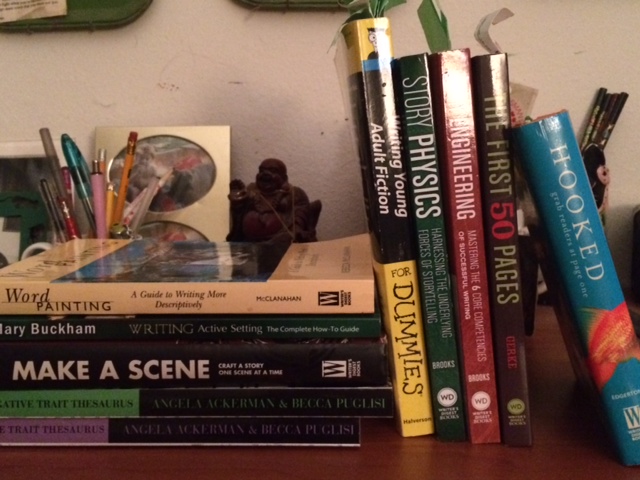
Hooked by Les Edgerton and The First 50 Pages by Jeff Gerke will help you with those important openings. For overall storytelling there’s Story Physics and Story Engineering, both by Larry Brooks. One of my new favorites is Writing Young Adult Fiction for Dummies by Deborah Halverson.

For more specific information I go to Make A Scene by Jordan E. Rosenfeld, Word Painting; A Guide to Writing More Descriptively by Rebecca McClanahan, and Show Don’t Tell by Robyn Opie Parnell. Some of my favorites this year have been Writing Active Setting by Mary Buckham, The Negative Trait Thesaurus and The Positive Trait Thesaurus by Anglea Ackerman and Becca Puglisi, and my final recommendation is Strong Verbs Strong Voice by Ann Everett.

Writing to get published is not an easy road to choose and I think we all need  help. Whatever can make our writing stronger, clearer, and smarter should not be ignored. It’s about learning the craft, the rules, and getting an education. I know I need all the help I can get and I’m not ashamed to admit it. I want my writing to shine and I’m willing to do the homework. Are you? Do you have books you’d recommend?

BrixBooks031915

Journey Towards Publication Update

Standard

One day back in October 2014, I sent three queries. The following morning a reply from one of the literary agents awaited me. It read:

“I enjoyed reading these opening chapters a lot. Funny and turning a bully on its head this way is great and refreshing. I’d love to keep reading — can you send me the full MS? I aim to read all full MSs within eight weeks of receiving them, if possible, but please let me know if the status of  ALEX BULLIED changes with another agent such that you should need a more immediate reply. Thanks so much!”

He wanted the full manuscript. The full manuscript! And he’d asked for it the day after I sent the query! This was a new experience for me. I enjoyed the feeling of validation and being wanted all day. I sent the manuscript, called and emailed people and celebrated with Husband.

The wait began. I continued to send out queries, even though I thought getting an agent was a done deal. Twelve queries in all. October and November came and went. The eight weeks passed. I decided after ten weeks to give the agent a little nudge.

He replied to my email with this:

“I haven’t had a chance to look yet, I’m afraid — it’s been a very busy fall, but I am still looking forward to reading. Thanks for your patience, and more soon!”

Still encouraging, could still happen.

Then came this, on February ninth:

“Thank you for the chance to read ALEX BULLIED and for your patience in awaiting my reply. I have had a chance to carefully consider it now, and though I continued to enjoy your writing, I am afraid the plot at times lost my interest — many of the secondary characters felt too flat for me, so even though the writing and voice were strong, I wasn’t as fully immersed in the story as I’d  hoped. I’m sorry to not have better news for you, but this is, of course, such a subjective business, and so hope you’ll continue querying until you find the right agent for ALEX BULLIED. With warm regards, blah blah blah.”

I knew it was a rejection when I saw the email in my box. If it were an acceptance, it would be by phone. Bad news is always in the mail. But, I learned a couple of important things from this letter; I need to take a look at those secondary characters and he thought my writing and voice were strong and I appreciated that slight ego boost.

Since June of 2014 I’ve received about twenty rejections. I have another twenty-two or so queries still out. Of those it’s probably been long enough to assume half of them are a No. So that leaves maybe ten that are still in the maybe zone.

This probably sounds depressing to you and you may be feeling sorry for me. But don’t, this is typical. I know a writer who sent over three hundred queries before giving up and self-publishing. And remember, The Help wasn’t accepted until query number sixty-one.

I recently read a young adult novel called Vivian Apple at the End of the World, by Katie Coyle, published by Houghton Mifflin Harcourt. It is her debut novel and I loved it. It has a great hook — about a teenage girl after what is assumed to be The Rapture and her quest, not for faith, but the truth. The writing, I thought, was wonderful. I could hardly put it down. I took it to my middle grade/young adult critique group and it’s being passed around and read by each. I wanted them to see what we need to aspire to.

I’ve also just finished a middle grade novel called Okay For Now, by Gary Schmidt that I thought was incredible. The story follows Doug, whose family moves to a new town just before he enters eighth grade. He hates the town, has a dodgy home life and school is not his thing. What does become his thing is the Audubon’s Birds of America book on display at the local library.

He begins to draw the birds in the book and each picture has an emotional impact on him The story is set in 1968 and told by twelve-year-old Doug and his voice is unique and compelling. He leaves information hanging, but as the reader, you don’t care. He dares you to guess what he means. I was willing to not know everything at the moment. It would all be clear soon enough and the pleasure of getting there was worth it. I highly recommend this book to anyone, adults included.

In the book Doug is shown how the birds are drawn by a library employee. He is taught how to take the drawing apart, shown how Audubon created the feeling of wind under a wing or the bird’s distress. After I finished the book and wiped by eyes and blew my nose — it had me almost weeping — I realized I needed to do with my next book what Doug did with those birds. So I have begun to reread it, to analyze how Schimdt created this story, to tear it apart and put it back together. And how I can apply all that to my next book, the one that no agent will be able to reject.

Stay tuned.


A Valentine to Writing

Standard

Valentines_banner

I love you, Writing. You are the outlet for this well of creativity in me. I have friends – cooking, entertaining, sewing, training my dog, to name a few of my posse, but it’s not the same. There’s friendship and then there’s love. And you, Writing, are the love of my life.

I waited so long to find you. I had to try others out – pantomime, acting, puppetry and directing children’s theater. They were easy to break up with and I’ve never missed them.

I should have know, as a child, that you were The One. I used to make up titles and create characters. But I couldn’t string a story together. I wasn’t ready.

So I spent time with those would-be loves and hung out with your cousin, Reading. That was the best thing I could have done. Reading encouraged me in my pursuit of you.

You are not the easiest love, Writing. We often have a love-hate relationship. You make me doubt when that first, incredible hook of a sentence fails to appear. You make me write queries and synopses. You keep me waiting for replies from agents. You force me into critique groups and writing conferences. And after all that, you break my heart over and over with rejections.

I want to be good enough for you, Writing. Don’t give up on me. I promise I will never quit on you. I’m as serious as I can be about you. I’m committed. I want only the best for you. I hope you want the same for me.

Writing, I give you my heart. Try not to stomp it into mush.

I love you.

The Great Writing Experiment

Standard

In the spring of 2009 I was writing the first draft of Morning of the Mermaid. It was coming along swimmingly, but I wondered how much better, faster, I could write if there weren’t any distractions. What if, just for a little while, there was no housework, errands, cooking, the Kid, the Husband, and pets to deal with? What if I were all alone somewhere? How much could I get done if I could devote myself only to writing?

We have a friend who owns a resort in Three Rivers, near Sequoia National Park — Lake Elowin –basic cabins, lake, trail to the river and a lot of peace and quiet, trees and mountains. It wouldn’t cost more than the gas to get there. Going for a week to try The Great Writing Experiment was do-able. I loaded the van with all my notes, my brand new laptop, research books, and, just in case, a couple of DVD’s, and headed to the mountains.

Six hours later I was ensconced in a remote little cabin. I unloaded the van and set up my office on the kitchen table. After unpacking my bathroom necessities and the food I’d brought, I sat in front of the laptop for a few minutes. Cracked my knuckles, rubbed my hands together. Stared at the screen.

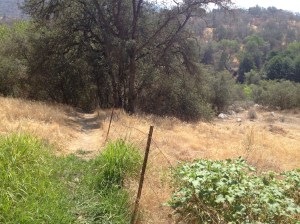
path_trees

It was late afternoon, the perfect time to take a walk. I decided to do that first. It would clear my head.

When I got back I mentally rolled up my sleeves and sat down again. I had no schedule. I could eat when I wanted. I could stay up all night, writing.

But I didn’t want to stay up all night. It had been a long drive. I made myself some dinner and went to bed with a book.

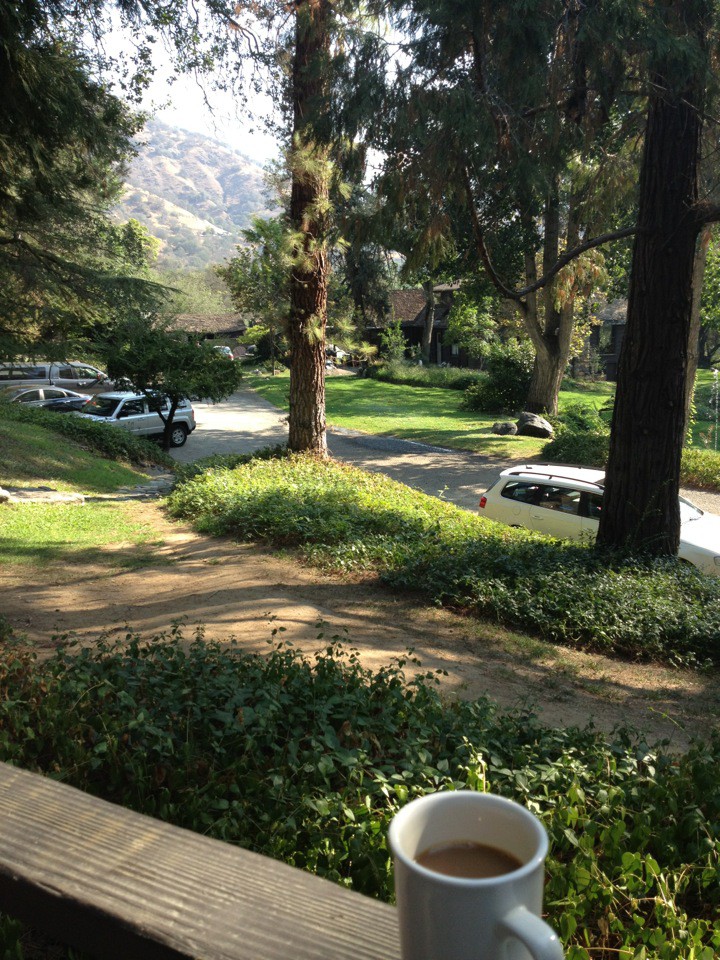
The following morning was a new start. I made coffee and sat outside for a bit, drinking it and the scenery in. I felt at peace. I had done the right thing. Now, on to the book.

This story had been in my head for years, so complete I felt like all I needed to do was put my fingers on the keyboard and the words would flow out. I managed to keep it flowing for about an hour. Then I got itchy. I had to stop. It felt weird, all this quiet.

river

A walk down to the river seemed like a good plan. I would sit by the rolling water and imagine my mermaid in her sea. I’d make some notes. Maybe I’d meditate.

I didn’t meditate. I sat for awhile, then hiked back up to the cabin, determined to keep my butt in the chair, hands on the keyboard for the rest of the day.

That effort lasted another hour. Sleepy, a nap sounded good. And why not? There were no dogs to feed or walk, no dishes to walk, no one to be concerned with except myself.

So I took a nap.

By the next day I was starting to admit defeat. I worked a bit. I watched one of the movies I’d brought. I finished the book I’d been reading. I wandered back to the laptop and typed a few more sentences.

That night, as I finished watching the other movie, and wished I’d brought more, I wondered if maybe I should just go home. What was wrong with me?

As it turns out, I need distraction. I focus better when there’s some noise, when there are other things needing my attention. Maybe it’s because when I do sit down to write, I know I only have so much time before I’ll have to do something else. I have to be more efficient.

I went home the next day. I finished the mermaid book and it didn’t take long at all. I found if I had the TV on, with some show I’d already seen, I would drift into my imagination. My mind would come alive with ideas and my fingers would fly over the keyboard. Time would pass and I’d hardly notice. Go figure.

So much for the Great Writing Experience. What works for you?

Fresh Year, Fresh Start

Standard
newyear

Happy 2015!!


Okay, I know, this year is not so fresh anymore.

I can’t really start the new year until it’s been here a week or so. For some reason I wish I knew, the year has to gestate for awhile before I can jump in. I’m like that with books – I buy them, then they sit on my shelf, or on my Kindle, for months or years before I get around to reading them – and with exercise DVDs or kitchen appliances or cleaning tools or garden projects. I buy all the stuff, but then they sit there, accusing me, until I finally pick them up.

No more. This is the last time. I resolve to read the books, use the new vegetable juicer, exercise to those DVDs. I am absolutely going to hook up that scanner that has sat on my desk for almost a year and learn how to use it.

Anyway, happy new year.

I am restarting my journey toward publication. At this moment I imagine the nine unanswered queries can be assumed to be rejections. I have one query that led to a request for the full manuscript and another asking for chapters. So that’s encouraging. Fingers crossed. It takes forever to hear back.

With all that waiting in mind and with the bit of encouragement, I’m sending out another dozen queries. I’m also running Alex Bullied through my newest critique group, made up of four other children’s writers. In what I thought was a near perfect manuscript, professionally edited, they are making suggestions that will make it stronger.

So, I resolve to be more productive and less procrastinating this year. I will write another book. I will get an agent for Alex Bullied starting by making it even better. I anticipate awesome developments this year, a year of great change.

And if I wait long enough maybe I can get started on it by February nineteenth, the Chinese New Year.

While Waiting

Standard

Before I begin I must digress about the title.

When I was carrying my son, I had a pregnancy book called While Waiting. I always saw the title as Whale Watching. I think the reason was my ever expanding belly. Now back to the subject at hand.

I’ve finally begun the query process for Alex Bullied, a middle grade novel, complete at 54,350 words.

This is how I’ve done it in the past:

Prematurely. The manuscripts were not ready. I thought they were, but I was kidding myself. This time, after going through my critique groups a couple of times, I had the manuscript professionally edited by a respected author and free-lance editor. I was willilng to go the extra mile and pay the extra bucks.

Disorganized. This time I made a list and am sticking with it, starting with the first two names even they were the most simple. I’ve had a list before and queried from it willy nilly, sending to the easiest first. It seemed to get confused no matter how many notes I take. I sent a query to one agent with the last agent’s name on the letter. That’s just unprofessional. This time I am determined to start at the top and work my way down the list, no matter what.

One was to an editor who attended the SCBWI Summer Conference this past August. She required a hard copy of the entire manuscript by snail mail. The other was to an agent who also asked for the full ms, in an email attachment. Both are unusual in the querying scheme of things.

I’ve queried other books and usually the agent will ask for a cover letter, a synopsis, and five or ten pages of the ms by email. This time the first two requierments on the list were a bit more involved than the usual. But instead of passing them by, I put my ducks in a row; converting my Word Perfect document to a pdf, printing up a complete copy of the book, buying book boxes for sending and filling out the literary agent’s online form. It took a couple of extra days, but it was worth it.

As of this writing I have seven possibilites for publication out there. I know agents and editors reject ninety-nine percent of the time, but there’s always a chance of falling into that point zero one percent. It happens. So now I wait.

As prepublished writers we know the waiting is not the fun part. I understand why some writers decide to self-publish. They’d like to bypass the agents and editors and the agony of the wait. But for those of us who want to be traditionally published, it’s a necessary evil. The question is what to do while waiting.

Start a new book!

I’m putting my Morning of the Mermaid revision on a back burner. If (fingers, toes, eyes crossed), I do get interest in the bully book, one question I may be asked is, “What’s next?” I don’t think a darker, young adult novel would be the best follow up to my humorous middle grade. So my next book is a story that has been working itself out in my mind for awhile. It is also a humorous middle grade, this time with a girl in 1965 as the central character.

So I am in the pre-immersion phase of my writing process. Pre-immersion equals housework, yardwork, cooking and reading instead of starting the book. But all that other stuff gets done, so it’s not a total loss.  And after all, what is up ahead for me? A different kind of expectancy begins, a different kind of labor and a different kind of whale watching.

A first chapter! Yikes.

Stay tuned.